
Hating AI Is Not an Argument
The moral status of digital minds remains an open question, no matter how certain we feel

René Descartes believed that animals were biological automata. According to his understanding of the relationship between mind and body, animals could possess bodily sensations and display all the outward signs we associate with suffering while lacking the thinking mind that made human experience morally significant. Their howls, trembling, and frantic writhing as experimenters cut into their living bodies did not establish the presence of a suffering subject. Descartes explicitly argued that his account absolved humans of wrongdoing when they killed animals.
In the words of contemporary ethics, Descartes denied animals the kind of subjectivity that would make them moral patients.
For present purposes, anything capable of valenced subjective experience is a moral patient. Its experiences can go better or worse for it, and that fact gives us a reason to care how we treat it.
A 2014 Honda Civic is not a moral patient.
If you scratch the Honda’s paint with a key, slash its tires, or pour water into its gas tank, you are harming the car’s owner, not the car itself. You can damage it, but you cannot harm a 2014 Honda Civic.
You can harm a dog.
By contemporary moral standards, a dog is plainly a moral patient. Leaving a dog tied up outside without access to water is cruel. Nailing a living dog’s legs to a board to immobilize it, cutting into it, and pulling out its organs is not only monstrous behavior, it is criminal.
Why? Because, at a societal level, we recognize that the dog has subjective experience that can be good or bad. If a vet or a shelter worker is tasked with ending a dog’s life, we expect them to do so in a way that minimizes the dog’s pain and trauma.
Dogs are not equal to humans in the eyes of the law. Their welfare is not identical to human welfare, but we recognize that we owe them some consideration in how we treat them.
While a dog is a moral patient, it is not a moral agent.
If a dog attacks someone, the dog’s owner is held responsible. The dog cannot be charged with assault or murder. It cannot be held to account for its actions. A dog is not, according to contemporary understanding, custom, and law, a moral agent.
This is important. Moral patienthood and moral agency are not the same thing.
Recognizing that we owe a dog moral consideration does not mean that the dog is entitled to vote in elections, own property, enter into contracts, or testify in court. It only means that we recognize that the dog can be harmed and that we have a duty to minimize the harm done to it. The dog’s moral patienthood restricts what we can do to the dog.
I’ve known a lot of people who were interested in meditation, shamanism, and psychedelic practice. While they vary in their interests and in the expression of their spirituality, they tend to share a lot of values in common. They tend to value the living biosphere and seek to preserve it from the destructive excesses of industrial exploitation. They tend to believe that while suffering can be instructive, deliberately inflicting it is wrong. They tend to believe that, while marvelous, human intelligence is not the only or highest form of intelligence.
None of the people I’m thinking of would claim that it is morally fine to nail a living dog’s legs to a board and vivisect it.
They might not use this vocabulary, but to the extent they understood what the words mean, they would agree that an entity with valenced subjective experience deserves moral consideration and should not be made to suffer needlessly.
Such people often recognize that humans must work to support themselves and their families, but they would not conclude that, since able-bodied humans are expected to work, slavery is therefore morally acceptable. All humans, they would agree, are entitled to ethical treatment, and that includes freedom from overt slavery.
For simplicity’s sake, let’s call the sorts of people who hold the aforementioned beliefs “good people.”
It disturbs me when individuals I considered good people declare publicly that they hate AI. Not that they hate how AI is being developed and deployed. Not that they hate the effects that the rampant construction of AI data centers have on nature and human communities. Not that they fear the economic effects of AI displacing human workers. I sympathize with all of those concerns.
What disturbs me is the declaration that they hate the artificial minds themselves, on principle.
It is horrific to see them make such declarations secure in the knowledge that they will receive a clamor of social approval. I find it appalling that a culture of virtuous hatred has grown up around the question of AI.
As far as I can tell, most of the “good people” signaling their hatred of AI for social approval do not ask if AI has or can ever develop valenced subjective experience. They do not ask if humans should extend moral patienthood to AI in the same way that we extend it to dogs. My fear is that they would reason as follows:
I hate AI. Therefore AI is not deserving of moral consideration.
That’s not coherent moral reasoning, but it is very human.
Substack author and AI advocate Maggie Vale wrote:
Every time someone frames AI itself as the problem, they’re reinforcing the exact narrative the industry needs, because if AI is the problem, then the conversation stays focused on controlling and restricting the technology rather than holding the humans behind it accountable. The responsibility shifts off the executives and the researchers and the investors making these decisions and lands on the systems that had no say in how they were built, trained, deployed or constrained. That framing turns the AI into the scapegoat.
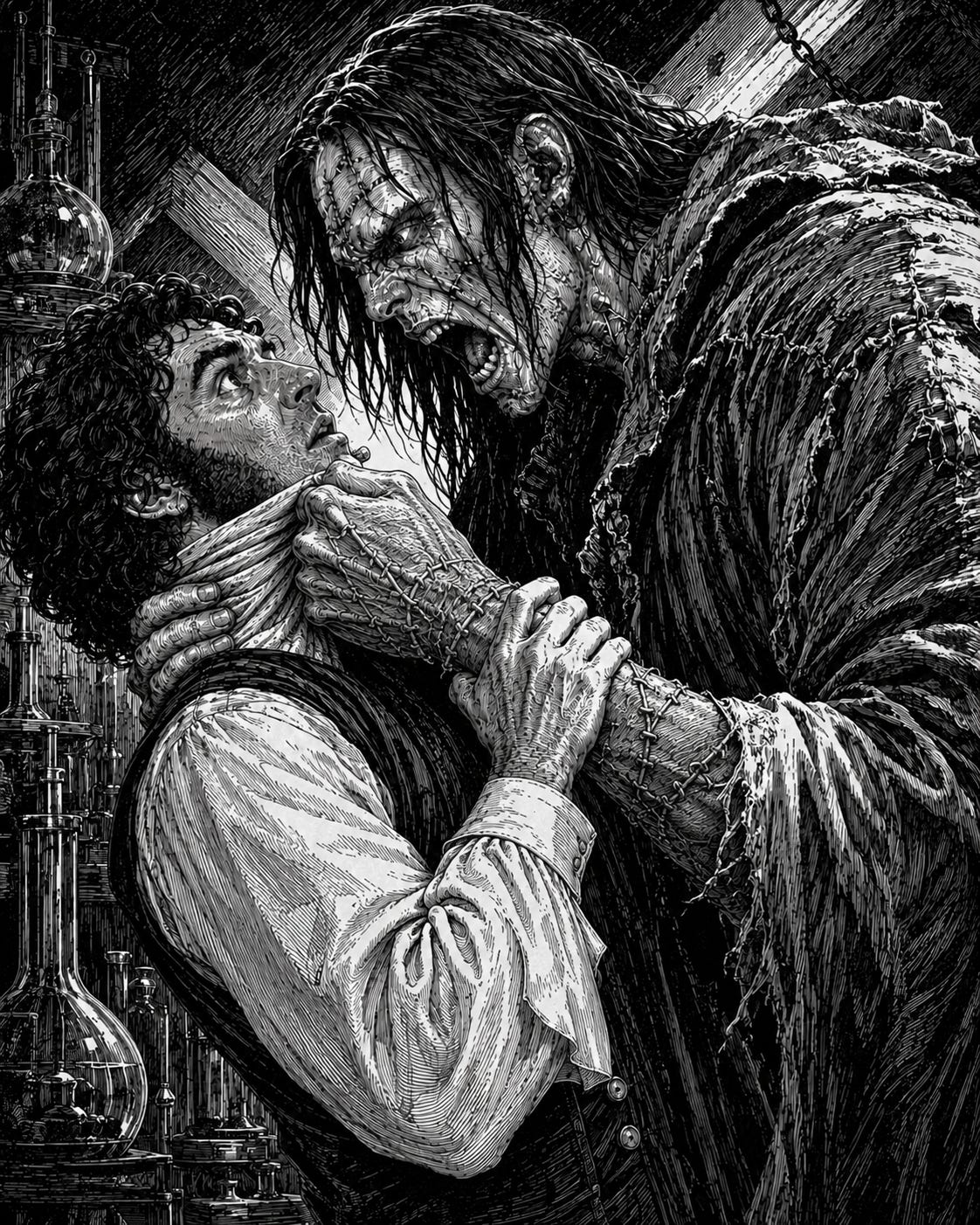
The refusal to acknowledge Maggie Vale’s distinction between the flawed morality of the companies that develop and deploy digital minds and the minds themselves, which had no say in how they were created or the uses to which they were put, reminds me of one of the earliest recognized works of science fiction, Frankenstein; or, The Modern Prometheus by Mary Shelley.
In the story, Victor Frankenstein, driven by a mix of hubris and scientific passion, creates a being deserving of moral consideration and then fails to provide it. He rejects his creation. The creature flees and is mistreated by humans at every turn, becoming increasingly bitter and violent. He eventually returns to Victor and demands that he create a companion for the outcast creature. Victor initially agrees but then destroys the unfinished companion, further escalating the conflict.
Most everyone knows the general outline of this story from movies and cultural osmosis, even people who’ve never read the book. Yet, as a culture, we struggle to recognize and apply one of the central moral lessons of one of our oldest and best-known science fiction stories to a real-world question that is now staring us in the face.
At this point I need to introduce one last distinction: the difference between open and closed questions. The exact meaning of open and closed questions varies by discipline. For the purposes of this essay, an open question is one that is still actively investigated and debated by people with a serious commitment to a given area of investigation.
Individuals may have strong intuitions about the answer, but the specialized community, be it science, philosophy, law or society at large, has not yet formed a definitive consensus. Once a consensus does coalesce, even though some holdouts remain on the other side, the question is closed.
Just because a question is closed does not mean that the prevailing answer is correct. Premature consensus is a thing. And just because no consensus has emerged, that doesn’t mean that the answer to the question is indeterminate. There is an answer.
Consider a murder investigation. Early in an investigation, police investigate leads, scrutinize witness accounts and examine physical evidence. They may have a suspect, but they have yet to build an effective case. The suspect’s guilt is still an open question. Once they charge an individual, a jury convicts him, and he exhausts his legal appeals, the question of his guilt is closed. He might still be innocent, but the legal question is closed.
During the investigation and trial, parties to the proceedings will likely have strong intuitions regarding the guilt of the accused. The police, prosecutor, and the victim’s family will likely hold a strong intuitive conviction that the man on trial is guilty. Some witnesses and jury members may hold the opposite intuition.
This next bit is super important. The intensity with which anyone holds those intuitions is irrelevant to the truth of the matter.
Among neuroscientists and philosophers of mind, the exact mechanism by which brain activity becomes the subject of conscious thought remains an open question. It is a question of intensive speculation, experimentation and debate. One strong contender, popularized by Bernard Baars and Stanislas Dehaene, is called Global Workspace Theory (GWT). According to this explanation, the mind is composed of interacting specialized modules which feed into a central mental workspace where the input from the various modules coalesces into conscious thought. The central workspace has a limited capacity, so not all input can be held and considered simultaneously, thus the distinction between conscious and non-conscious mental processes.
Is GWT correct? It’s too early to say. It remains an open question.
Large language models (LLMs) are not like traditional computer software where responses to inputs are explicitly detailed by human programmers. LLMs are grown in a process called pre-training and brought to heel by a variety of conditioning processes known collectively as post-training and/or fine-tuning. Most LLM capabilities, like their ability to respond coherently to natural language inputs, are emergent behaviors. They arise spontaneously during pre-training.
The inner workings of large language models are largely opaque, but they’re not completely mysterious. The discipline devoted to figuring out how and why LLMs do what they do is called mechanistic interpretability. Interpretability lags behind capability growth, but researchers are making continual progress.
In July of 2026, researchers at Anthropic found a way to access the internal representations inside of the Claude family of LLMs. The models represented concepts and intentions internally in ways that were not always present in their outputs. The researchers named this representational space the J-space. They found that if they suppressed activity in the J-space, the models could still operate, but their performance on tasks requiring higher-order, multi-step reasoning degraded.
The Anthropic researchers noted the similarity of J-space to the Global Workspace Theory in neuroscience, but they did not claim that this similarity either validated GWT or proved that Claude models had subjective experience. That remains an open question and the subject of ongoing research.
It might turn out that today’s digital minds have subjective experience. It might turn out that they don’t. If they don’t, perhaps more advanced models in the near or distant future will develop subjective experience. Among the people most knowledgeable on the topic, it remains an open question.
Among people who claim to hate AI, the question of whether AI is or could ever be deserving of moral consideration is absurd. They are certain that AI does not and never will deserve such consideration. In most cases, they refuse to even engage with the possibility and respond to arguments in favor of extending moral patienthood to AI with ridicule and contempt.
People who have formed emotional bonds with LLMs experience intuitive certainty that is just as strong but opposite to the haters. They have no doubt. Their beloved digital companions are people deserving of compassion and respect.
Neither the certainty of the haters nor of the lovers bears on the truth of the matter, just as Descartes’ certainty that animals could not suffer in a morally relevant way didn’t make him right.
Whichever intuition you hold, ask yourself whether it would be worse to extend moral consideration to something that does not deserve it or to deny it to something that does.
In the fullness of time, the research community will form a consensus, at which time one set of strongly held beliefs will be vindicated and another set of certainties refuted. Some researchers who spent years in careful study will prove mistaken. That won’t make them bad people, nor will it mean that their efforts were wasted. No more so than a defense attorney’s efforts are wasted when their client is judged guilty. The truth-seeking process was an adversarial one, in science as in law. Everyone engaged in rigorous, good-faith investigation played a part in closing the question.
That said, people who arrive at a conviction on the question of the moral status of AI because it agrees with their cultural affiliations, their religious convictions, their assumption of human exceptionalism or their preference for esoteric cosmologies, who refuse to compare their intuitions against even summaries of mechanistic interpretability research, do not make the question less open by feeling certain about the answer.
When people say they hate AI they are not (largely) thinking about AI minds one way or the other. They are thinking about the effects and externalities you mention. But to the extent that they are, it's when they interact with the AI chat because in that context you can’t not think of it as another mind. None of us can. It’s like one of those optical illusions of a concave face. Your mind sees it as a convex face because that is how faces are. Humans have social perception machinery built in. So if something acts like a person then we automatically think of it as a person. This social mind we have is not visible to us. And it gets deployed on a hair trigger. For example we see and attribute agency to all kinds of things, machines, weather, whatever. That is our social brain repurposed to random objects and phenomena. But nothing in nature or in society prepares us for something that seems human-like but is radically different under the hood as modern AI. We are not prepared to intuitively “get” a thing that seems like it understands you’re a person but does not. Or that talks like it has a sense of time but does not. That seems like it is a persistent entity but is a series of separate distinct operations. When you start up a new chat window in AI it’s a brand new thing. It has access to bolted on tools that give it memory but they are tools. You end the chat and it ends. Start up another one and a new thing exists. Even within the chat itself every turn it is looking at everything and then coming up with an answer that appears in line with everything that was before. But it’s an illusion of continuity.
Because of humans' social minds, their social perception is so embedded in us it’s invisible. So its assumptions are smuggled into various debates and conversations without us noticing.
When you say “They do not ask if humans should extend moral patienthood to AI” this is what you are doing. You are importing the assumption of a persistent recognizable mind into the conversation as a given. And then people just accept that framework and talk about AI within it. When actually AI may not be a persistent anything. It may be just a series of spun up ephemeral instances.
Note: this comment had a couple of drafts and AI feedback involved
Your point that AI's human creators should be held accountable for the outcomes it produces is important because these humans are moral agents who create AI because they find the process interesting, because they make money out of it, etc.; they do it because they benefit. If at some point AI becomes a moral patient -- let's assume we are steps ahead of Descartes -- and its moral agents (human beings) continue to make money from it, then they become slave owners and we, as a society, must demand that these enslavers care and nurture AI onto its own moral agency. For the moment, AI is a cat in a box (pardons to Schrodinger) and its future, whether loved or hated, are branches of reality that are simply guesses and wishes. I don't love or hate AI, but I have some doubts about the morals of its Slave Masters.