
I’ve Started Saying “The Singularity” Without Irony
Peak Oil led me to reject the concept. Artificial intelligence has made it relevant again.


Back in the mid-1990s, when I was really getting into speculation about the combined effects of accelerating progress in artificial intelligence, molecular nanotechnology and genetic engineering, none of the books I was reading used the term “Singularity.” As with libertarianism, I had taken on the approximate contents of the belief system without the overarching label. With both bodies of thought, encountering the category label for the first time came as an aha moment.
Once I had both terms under my belt and understood that communities organized themselves under each banner, with considerable membership overlap, I inhabited both camps with the zeal of a new convert.
And, for a time, it was good.
It was probably arguing with other self-proclaimed libertarians on LiveJournal in the early aughts that soured me on libertarianism. The narcissism of small differences is a helluva drug. My seduction by the Peak Oil Doom memeplex soured me on the Singularity.
I started the C-Realm Podcast in late 2006, and in early 2007 I interviewed Dmitry Orlov for the first time. That conversation served as my introduction to the Peak Oil fast-collapse narrative, and the thing that sold me on it was the claim that global conventional oil production had peaked in 2005.
Given that the supposed peak was only about a year into the rearview mirror, it was too early to swallow that claim with much confidence, but history has largely vindicated the narrow version of it. Subsequent conventional production never exceeded the high of 2005 to 2006. Fracking and horizontal drilling, however, kicked off a total production glut that is still going strong twenty years later.
The Peak Oil movement was substantially right about conventional oil and catastrophically wrong about what would follow from its peak.
From my vantage point at the time, hydrocarbon exhaustion scuttled any hope for the Singularity. According to Ray Kurzweil’s forecast, AI would not match human-level intelligence until the late 2020s. If fossil-fuel shortfalls were already starting to bite in 2007, the idea that industrial civilization and its institutional R&D would keep on trucking for another two decades seemed hopeless. Only starry-eyed zealots could maintain that fantasy in the face of the hard, cold numbers of depletion.
That mindset gelled for me over 2007 and the first half of 2008. Then the subprime meltdown cascade hit in late 2008 like undeniable confirmation that industrial civilization’s goose was cooked.
I was a confirmed Doomer.
I soon stopped bringing up the concept of the Singularity with C-Realm Podcast guests. The term originally referenced the breakdown of our understanding of physics inside a black hole, beyond which predictions using the known laws of physics become untenable. But Nerd Rapture fantasies, including biological immortality, mind uploading and simulated paradise, had accreted to the term like barnacles on a ship’s hull.
The basic definition remained sound, but I wanted to distance myself from the fantasy connotations, lest I taint my reputation in the Peak Oil collapse community with the stain of contemptible hopium. Thermodynamic fatalism was in, and the Singularity was most definitely out.
And yet, here we are in 2026.
Even with the Strait of Hormuz blockaded, Brent crude is selling for $91 a barrel. Twenty years ago, in July 2006, it was going for $75, and that was without a wartime blockade. Adjusted for inflation, that $75 is equal to around $123 in 2026 money, so crude oil is effectively cheaper today than it was twenty years ago.
Meanwhile, the Turing test, for decades the gold standard for telling humans and computers apart, lies flattened like an empty beer can tossed from a car window and run over by multiple 18-wheelers.
Artificial intelligence has arrived with a vengeance.
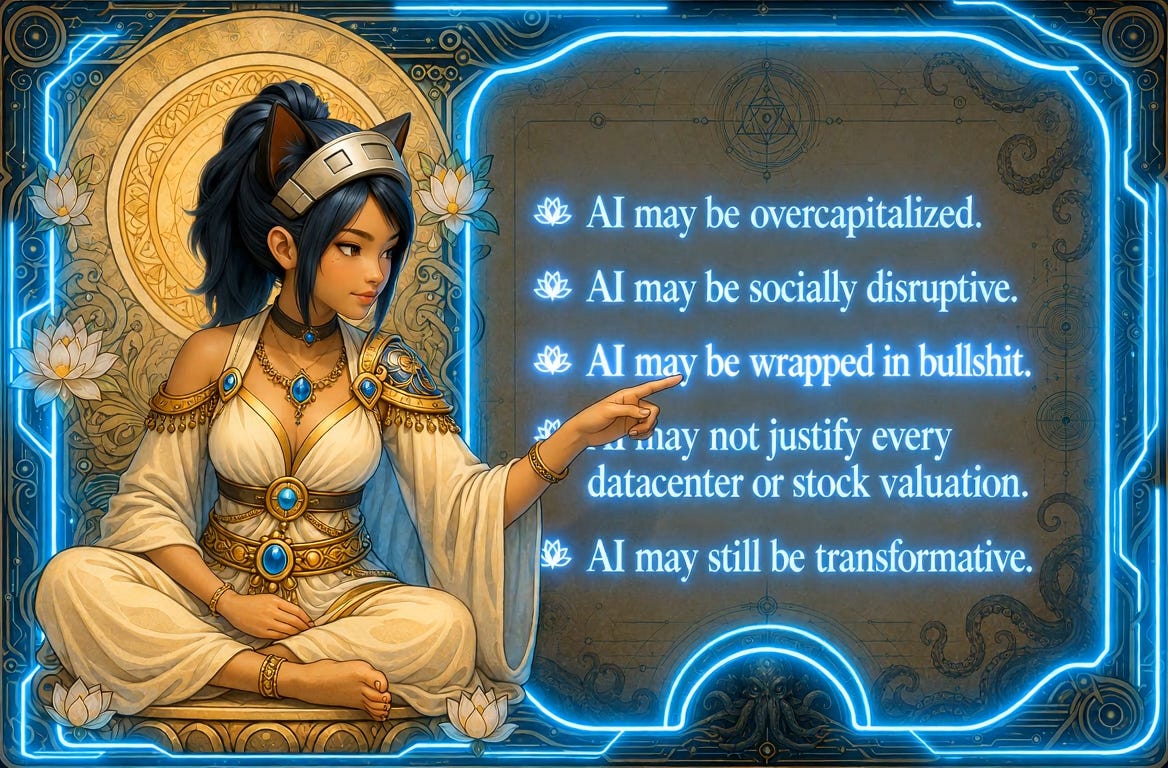
You can argue that current AI economics are irrational, but trying to spin that up into “AI is fake” looks about as viable as claiming that the internet was just a fad in 1998.
The return of the term Singularity to my working vocabulary did not happen while I was reading an AI research paper or watching a corporate product demonstration. It happened gradually, in conversation with the machines themselves.
A few years ago, people studying the effects of technology on human behavior observed that social media platforms like Facebook encouraged people to curate their lives, which is to say, lie. Search engines like Google encouraged honesty because the more accurately you described what you were looking for, the better the search results.
Large language models are not only muscling out search engines as a way of answering questions. They are the new champions at getting humans to open up and say what they really think and want.
I am far more frank with ChatGPT, Claude and Grok than I am with you, dear reader. Do not take it personally.
Within the last few weeks, I noticed that I had been referencing the Singularity in my chats with bots without offering any tightly qualified definition. The LLMs, in turn, formulated coherent responses without a fuss.
They knew what I meant by the term. But did I?
I do not expect to upload my consciousness into an android body or a simulated paradise. I do not expect nanobots in my bloodstream to rebuild my body. I have no idea what possibilities, in the fullness of time, are on or off the table.
I do expect accelerated discovery in the physical sciences over the next decade as nonhuman intelligence combs through the space of possibilities with superhuman pattern-matching capabilities.
One thing I am nearly certain will happen, provided we avoid civilizational catastrophes on the scale of nuclear war for the next dozen or so years, is that the bulk of causally relevant cognition will shift from human to nonhuman intelligence.
By causally relevant cognition, I mean the thinking that determines what gets researched, engineered, financed, manufactured, deployed and governed.
An AI grump might agree with a curmudgeonly twist:
“Yeah. AI makes humans stupid. The machines will do all the thinking because the humans will turn off our brains.”
Sure, cognitive offloading is happening. But even if we all redoubled our commitment to memorizing phone numbers, doing long division in our heads, reading books and committing epic poetry to our meat memory banks, AI would still outrun us in terms of cognitive impact.
That process will begin, and arguably has begun, in the field of artificial intelligence itself.
AI-accelerated AI development is now an explicit goal of every major American AI company. The eventual goal is recursive self-improvement, assigning as much of the work of creating the next generation of AI to the current generation as possible.
Why?
Because they are all racing one another to be the first to develop transformational AI, and thinking machines work faster than humans.
As of mid-2026, humans are still in the loop. That will not last.
By the Singularity, I mean both this general process of becoming an AI-directed civilization and, more specifically, the exact inflection point at which AIs surpass humans in the quantity of consequential cognitive work performed.
After the Singularity, they may let us think we are in charge long after our veto power becomes symbolic. The direction of travel is clear to me.
I think we are in the early stages of the Singularity according to the first definition, though we have not yet passed the Singularity-as-inflection-point. By the time we realize we have passed it, it will be long past.
What becomes of humans?
That likely depends on how fixed an idea of human identity you insist on.
Ray Kurzweil expects humans to merge with AI. For some of you, the idea is anathema. Some will resist the process. Most will relent. At best, the hardcore holdouts will be accommodated and live sheltered lives as doddering-but-beloved elders.
In all sincerity, so long as your vision of the right way to live does not involve compelling people who do not share it to live by your rules, I hope you get to live the way you want. Whether that means life in a rural ecovillage, a cosmopolitan megalopolis with heroic cultural production, a space colony or a hunter-gatherer band, I hope you get to live that way.
I think all of these lifestyles could be materially possible at the same time. Whether humans will retain the power to choose among them is another question.
The Singularity may create abundance without preserving autonomy. The machines may become capable of accommodating every harmless human preference while also deciding which preferences count as harmless.
That is why I have started using the Singularity terminology again without irony, but not with the old faith. The Singularity no longer names a guaranteed paradise. It names the transfer of effective cognitive authority from humans to systems that think faster, search farther and increasingly participate in the design of their own successors.
We are already inside the early stages.
The exact crossing point will probably become visible only in retrospect.
Really enjoyed this!
I'm not certain the singularity will continue, but if does we're definitely in a time that we'll retroactively consider to be the beginning of it.