
Time Loop Tropes
Why Groundhog Day remains the GOAT

1993’s Groundhog Day is both endlessly plagiarized and paid reverent homage. At the same time, under the current Hollywood Zeitgeist, no major studio will risk retracing its steps in full. It’s a 32-year-old classic that was both a hit in its day and maintains cult-like devotion. Isn’t it strange that it’s never gotten a re-make? It’s not strange once you realize that it represents an extinct narrative form.
Groundhog Day is a crucible. Every film to repeat its formula is a workshop.
Say what?
This will take some ‘splainin’.
I’m a sucker for a time-loop story. I re-upped my Netflix subscription to watch Guillermo del Toro’s Frankenstein and K-Pop Demon Hunters. Afterwards, rather than just revisiting my favorite episodes of Love, Death & Robots and then forgetting that Netflix even exists for another year, I poked around to see what else might hold my interest. Some wily algorithm dangled a description for The Lazarus Project in front of me, and I was hooked.
A man develops the ability to perceive shifts in time and joins a top-secret government agency that manipulates time to stop global disasters.
I’d recently watched Kill Me Again, a time loop story set in a diner with a serial killer as the POV character. The fun and games portion of the story consists of him gleefully killing the dozen other customers and staff over and over. It’s not a great movie. It has its moments, but I couldn’t even say it’s a good movie. Even making bad movies demands extraordinary perseverance and commitment. Making good movies? Fuggedaboutit.
Point being, I watched it and got something out of it, but I don’t recommend it to anyone other than time loop movie completists.
Then I watched a video in which Daren Van Dam lists 15 underappreciated scifi masterpeices. That listed includes Palm Springs. It’s a time-loop story in which a slacker dude endlessly repeats the day of a wedding of two people he barely knows. I stopped the video right there and searched Roku for it. It’s a Hulu production, so you can find it there or on Disney+.
I watched it. It is a thing of beauty.
!!!SPOILER WARNING!!!
You know from the title that I’m going to get around to comparing every time loop story to the OG, Groundhog Day. I assume everyone reading this has seen Groundhog Day multiple times and knows it well, even if it’s been years or decades since your most recent viewing. I’m also guessing most readers have not seen Palm Springs. To make my points, I’m going to have to deploy one late-plot spoiler. It’s a delightful film that I highly recommend, so if you’re into time loop movies and if a spoiler would keep you from watching it, stop reading. Seriously. Go watch Palm Springs.
I’m also going to drop some spoilers for Edge of Tomorrow and The Map of Tiny Perfect Things. You’ve probably seen the former but not the latter. As with Palm Springs, I’m going to reveal something from late in the Map plot, so there’s another one to watch before coming back to this post. The Map of Tiny Perfect Things and Palm Springs would make a great date night double feature.
Okay. There’s the map: Groundhog Day (1993), Edge of Tomorrow (2014), The Map of Tiny Perfect Things (2021), and Palm Springs (2020). Despite what’s coming, I want to make it clear that I love all four films. They are the cream atop the time loop milk.1
The OG:
Groundhog Day wasn’t the first time loop story, but it is the foundation of the timeloop movie genre. Every subsequent time loop story hits most of its beats or, as in the case of Palm Springs, mentions them in passing on the assumption that you’ll grok the reference.
In the movie, TV weatherman and raging asshole, Phil Connors, climbs into a van with a doofus cameraman and a producer with a sincere soul to drive to Punxsutawney, Pennsylvania to cover the annual Groundhog Day festivities. There’s a big snow storm that closes the roads, stranding them in the small Pennsylvania town. The stage is set and the timeloop begins.
Cynical, ambitious Phil is allergic to Punxsutawney’s rural wholesomeness, so being stuck there rubs him the wrong way. Suckiness turns to nightmare when he wakes up in his B&B the next day to radio morning show banter that he recognizes from the previous morning.
I won’t recount the whole plot. You know it, but Phil’s arc hits seven beats that most future time loop movies will either replicate or reference:
Confusion - It takes Phil a few resets for the initial confusion and panic to wear off.
Hedonism - Once he figures out that his actions have no consequences, he stuffs himself at the diner, uses knowledge asymmetry to seduce women, and engages in dangerous thrill-seeking.
Tactical mastery - Phil learns to navigate and exploit the repeating Groundhog Day patterns in Punxsutawney. For example, he casually robs an armored car via perfect timing.
Struggle with meaninglessness - No consequences also means no lasting value. Phil realizes he can’t move forward or build.
Total despair - Phil is driven to suicide only to discover that it provides no escape. After repeated attempts at self-negation he enters a state of ambulatory catatonia.
Breakthrough - He discovers that unlike hedonism and strategic mastery, he finds lasting satisfaction in self-cultivation and helping others, even though nobody remembers what he did for them.
Transformation - He becomes a better person, escapes the time loop, gets the girl and decides to stay in Punxsatawney even though he’s free to leave.
The Trope of Transformation: Magical Realism to LitRPG
2014’s Edge of Tomorrow is the Aliens to Groundhog Day’s Alien. In it, Cage (Tom Cruise) is a public relations specialist for the US Marine Corps who goes to England to document a major offensive against an extraterrestrial invasionary force on the European mainland. He pisses off a general and gets assigned to a front line assault craft against his will. He dies and wakes up on the tarmac of a military base just before the invasion. Repeating the D-Day-like deployment again and again, he overcomes his fear and confusion and starts to replicate Phil Connors’ tactical mastery of his situation owing to his unique perspective.
Edge of Tomorrow takes Groundhog Day’s familiar time loop and premise and changes it from a solitary crucible for self-transformation into a workshop in which multiple characters collaborate to solve the puzzle the situation presents. Like Bill Murray’s Phil, Tom Cruise’s Cage is a piece of shit, and, like Phil, he becomes a better person over the course of the movie, but that’s not the focus of the narrative. The point is hacking the time loop.
Groundhog Day never explains the source of the time loop nor confirms its rules outside of Phil’s experience. It trusts the audience to follow Phil on his journey even though no authority ever articulates the exact nature of the experience. That level of respect for the audience is a thing of the past.
Edge of Tomorrow, in specifying a mechanism for the time loop, transforms magical realism into litRPG. In Groundhog Day, Phil has no clues to chase; no opportunity to solve the time loop puzzle. He can’t master his situation, so he must master himself. Edge of Tomorrow provides Cage with both an explanation for his recurring experience and the perfect action environment in which to grind and level up his stats.
Edge of Tomorrow also dispenses with the solitary male protagonist who must acknowledge his own inadequacies through seemingly inescapable cycles of suffering and self-confrontation. Instead, it turns the male POV character’s transformation over to a female wisdom-keeper. Cage levels up on his own, but he figures out that another soldier, Rita Vrataski, the legendary Angel of Verdun, understands what he’s experiencing. Cage locates Rita on the battlefield. She recognizes that he is experiencing a time loop and, just before she is killed, tells Cage to find her again. He does and she first kicks his ass to demonstrate that she is a higher-level alien fighter than he is and then drops the specifics of this movie’s timeloop mechanics on him.
From that point on, they’re a team, and even though Rita’s memories no longer carry over from one loop to the next, Cage knows how to bring her up to speed each time.
This new plot element, the female wisdom-keeper/co-looper is a permanent mutation that carries over from Edge of Tomorrow and persists through The Map of Tiny Perfect Things, Palm Springs and even films like Source Code and ARQ and streaming series like The Lazarus Project.
It’s not just that the idea of a male character achieving philosophical realizations without female guidance and validation has become ideologically suspect in the contemporary elite zeitgeist. Giving the person caught in time the loop co-loopers allows the writers to reveal and process the events of the narrative through surface-level dialog. That way you don’t have to trust the audience to make sense of what they’re seeing. It provides a structure for spoon-feeding everything to them without any ambiguity.
Silly Man, this isn’t even your story
The Map of Tiny Perfect Things takes the Groundhog Day template for granted and subverts it with extreme prejudice. Mark (Kyle Allen) is our point of view character. We can see that he’s in a timeloop, but unlike Bill Murray or Tom Cruise, he is utterly failing to level up or develop tactical mastery of his situation.
He spends his days trying to establish a social connection to a pretty young woman at a public pool, but despite his time loop advantage, he always fails. He tells his guy pal about his time loop dilemma. This is a standard time loop trope. When you’re stuck in a time loop here’s no need to keep it a secret. Anybody you tell will forget at the start of the next loop. People will think you’re crazy, but your reputation also resets with each new cycle.
Eventually, Mark meets Margaret (Kathryn Newton), who has a strange vibe about her. Mark follows Margaret around and learns that she also maintains her memories across loops. As it turns out–here’s the spoiler–Mark is an NPC in Margaret’s time loop. It’s her story; not his. The loop is the external manifestation of her emotional struggle. It will end when she is ready to move on and not before. The state of Mark’s self-knowledge is irrelevant. He’s just there to bear witness and to be a co-looper with whom Margaret can process her psychological struggles through dialog. That’s why Mark fails to achieve either tactical or personal mastery in spite of being time-loop-aware. Growth is for protagonists, and he’s not the main character. Margaret is. He’s just an ambulatory vantage point with an eye for beauty.
I’m not shitting on The Map of Tiny Perfect Things. I enjoyed it and recommend it. It’s a somber, poignant little film, and its ambition is perfectly calibrated to its capabilities. If you haven’t seen it, you should.
Palm Springs - When Personal Growth Doesn’t Cut It
Thirty one years and multiple iterations of the time loop movie separate Groundhog Day from Palm Springs. The Matrix had to demonstrate bullet time, but thereafter, you could invoke the concept with a phrase and people knew what you meant. The same is true for the time loop. Nyles, the protagonist of Palm Springs, makes casual reference to the concept when explaining his situation to Sarah, and she doesn’t ask for any clarification, only details.
The concept is so familiar that the film introduces Nyles after he’s been in the time loop long enough to know every detail and every possible cascade of cause and effect in his goldfish bowl reality. Nobody mentions time loops, but we can tell by his vibe and actions that he’s in one.
He’s staying at a desert resort for the wedding of his girlfriend Misty’s BFF. Misty, is a shallow beauty who is cheating on Nyles and likely goes through a lot of boyfriends. Nobody at the wedding knows Nyles, and even though he’s spent subjective decades with all of them and speaks to them with devastating familiarity, they barely recognize him and can only make sense of him as Misty’s boyfriend.
Nyles starts the day having perfunctory, unsatisfying sex with Misty and then dons a pair of yellow swim trunks and a Hawaiian shirt. This is his uniform for the entire movie. He proceeds to the kitchen to mix up a blender full of some frozen cocktail and then maintains his buzz throughout the day and evening with beer. He carries multiple cans with him everywhere he goes and cracks them open at inappropriate moments. He stays forever drunk.
Sarah (Cristin Milioti) is the bride’s older sister who, by her own admission, drinks and sleeps around too much. She’s clearly very uncomfortable at her saintly younger sister’s wedding. Nyles seduces Sarah and inadvertently pulls her into the time loop.
When Sarah wakes up and discovers that it is, once again, the morning of her sister’s wedding, she freaks out, attacks Nyles, and, when she runs out of cans of beer to throw at him, demands to know what he’s done to her. In the extended course of Mark’s explanation he makes references to his passages through the familiar time loop emotional beats including his many suicides. But where Bill Murray’s Phil emerged from his dark night of the soul to personal transformation and liberation, Nyles crashed in the valley between total despair and breakthrough and strung a hammock there. He stopped trying to escape a long time ago. Now he just stays drunk and expends the least possible effort to keep himself amused.
The fun and games portion of the movie comes when Nyles takes Sarah on a tour of the subtle revealed pleasures of his world. He is too lazy to have used the time loop to learn anything particularly useful, but he’s a master of darts and billiards from an eternity spent at a nearby dive bar.
Now that Nyles has a co-looper, he’s satisfied to spend eternity with her, but Sarah doesn’t share his contentment. She is determined to solve the puzzle of the time loop and escape.
Groundhog Day and Edge of Tomorrow differ in plot, tone, genre, and setting, but given that they are both time loop stories, the most significant difference between them is that Bill Murray’s time loop is a crucible and Tom Cruise’s is a workshop puzzle. The former can never yield to study or hacking, forcing an inevitable confrontation with one’s own failings and inadequacies. The latter is unaffected by your personal epiphanies. It has a solution and your job as the protagonist is to crack it.
Here’s the big spoiler for Palm Springs: Unwilling to languish with Nyles for eternity at her sister’s wedding, Sarah resolves to make her escape. When physical flight and emotional catharsis fail to break the loop, she hits the problem head on by taking her laptop to a diner with wi-fi and grinding her way to a mastery of quantum physics via YouTube videos, online courses, and Zoom calls with experts. It’s presented as a montage and the movie makes no effort to dodge the absurdity of this feat.
The male slacker was content to languish in low-stakes comfort for eternity, but the hard-charging girl boss met the problem head on and smashed through every barrier with indefatigable grit. The feminist tropes that rule contemporary Hollywood are on full display, but with a wink and a nudge. Unlike poor Mark in The Map of Tiny Perfect Things, Sarah doesn’t muscle Nyles out of the protagonist’s role. He wants her to stay in the loop with him. She’s leaving with or without him. The only tension left takes the form of Nyles’s internal struggle.
Sarah has worked out a means of escape that involves blowing themselves up with C4 at the right place and time. She has good reason to believe her plan will work, but she has no idea when or where they will emerge from the loop if it does. They could end up dead or worse. She doesn’t care. She’s leaving. Mark can man up and go with her or play it safe and float in the pool at a resort in Palm Springs, alone for eternity. The culmination of the film rides on his choice. He’s still the main character.
Save the Cat
Hollywood, under current management, would never green light another solitary crucible time loop movie. They might re-make Groundhog Day, but they’ll appoint Rita to be Phil’s co-looper and wisdom-keeper. Or there will be a mystical repairman like Don Knots in Pleasantville or Chevy Chase in Hot Tube Time Machine. Or Morgan Freeman will provide a magical negro omniscient voiceover narration. They won’t let the hero face an unexplained time loop alone and leave him and the audience to work out what it means. They’ll find a way to turn it into a workshop.
That said, Hollywood can never quit the time loop formula because it maps perfectly onto Blake Snyder’s Save the Cat story structure. You’ve probably heard of STC, but for the sake of concision, I’ll leave the explanation to Five2:
The Save the Cat structure is a simple narrative arc built around one idea:
a character begins in a stuck, flawed state, is forced out of their comfort zone, experiences rising complications that expose their weakness, hits bottom, gains clarity, and returns transformed.
Thanks, Five. That would have taken me 150 words.
I’ll just add that before the character makes the fundamental change the story requires of him, he will adopt some other strategy that yields positive results for a time. This initial run of success is the fun and games portion of the STC progression. It is the promise of the premise that forms the heart of the advertising for the movie.
The seven stages of Phil Connors’s Groundhog Day time loop journey map perfectly onto the Save the Cat story structure, an indispensable Hollywood story scaffolding. It is a progression of emotional stages that a character must pass through. Slot in a story detail to fill each blank in the STC beat sheet and you’ve got yourself a plot.
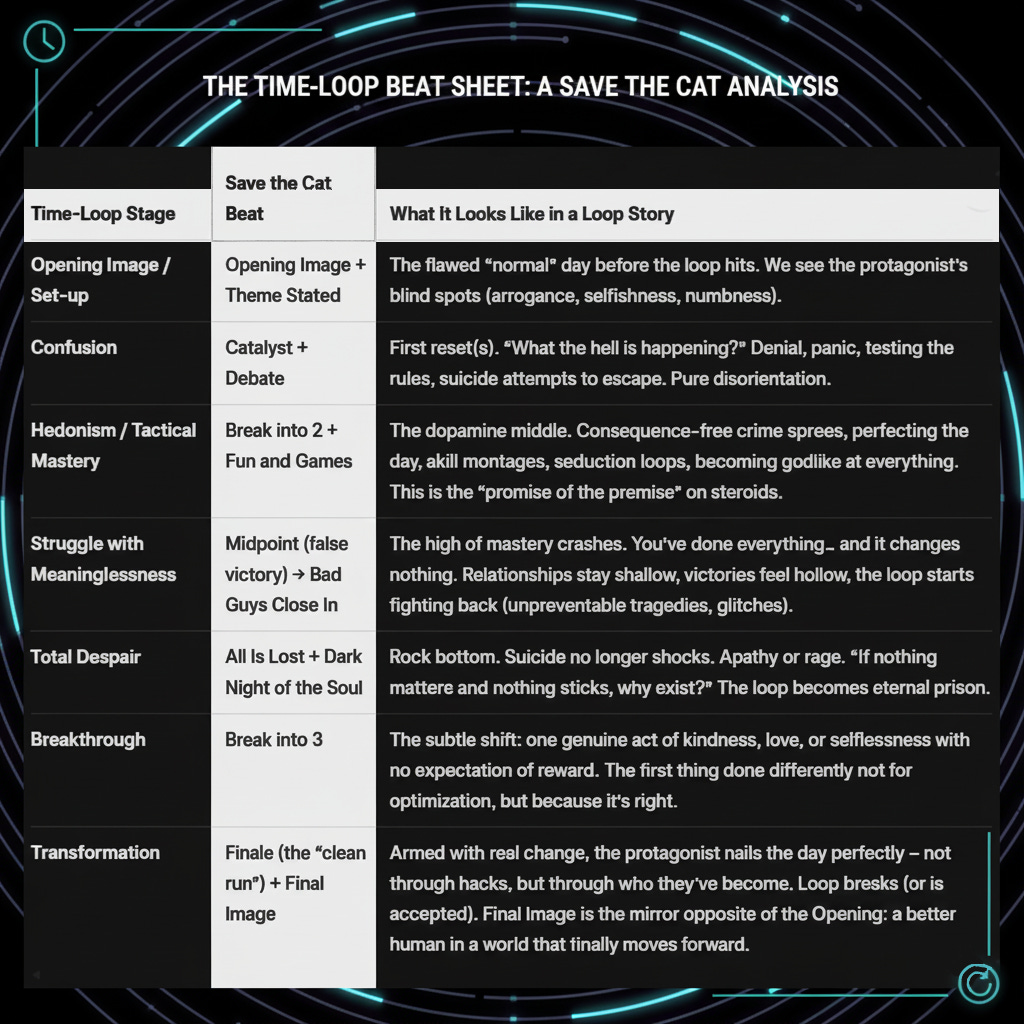
Time loop stories undermine plot by breaking causality. In effect, this transforms the emotional beats into literal plot points. For example, save the Cat has the character respond to the story catalyst with a period of debate before committing to the obvious course of action. In the time loop story, this is the character’s struggle to accept the reality of the time loop. He tries to reject it at first, to explain it away as madness. When it doesn’t go away, he moves into hedonism and technical mastery, the fun and games portion of Save the Cat.
As the time loop continues, the novelty wears off. The character struggles with meaninglessness and succumbs to despair. In Save the Cat terms, the bad guys close in and all is lost. Then when he has exhausted the methods for avoiding the confrontation with his flaw, he faces it, is transformed and emerges victorious.
The pitch writes itself. Groundhog Day meets Starship Troopers equals Edge of Tomorrow. Groundhog Day as earnest YA romance yields The Map of Tiny Perfect Things. Groundhog Day as an ironic, meta-aware romcom gets you Palm Springs. It’s just too perfect for Hollywood to abandon.
When I get this posted I’m either going to continue with The Lazarus Project, which is Groundhog Day meets Slow Horses, or I’m going to watch Boss Level, which looks like Groundhog Day meets Hardcore Henry.
The crucible is out of fashion, but the loop is eternal.
There are MANY other time loop movies, series and games. This post would turn into a book if I tried to wrangle them all. Those four movies provide all the examples we’ll need, but for the sake of SEO, here’s the full list as of Q4 2025:
Movies – The Core Canon
Groundhog Day (1993) – The original and still champion; solitary moral loop in small-town purgatory.
12:01 (1993) – Dark, overlooked corporate-hour loop that actually predates Groundhog Day in short-film form.
Run Lola Run (1998) – Three alternate runs, not a pure memory-retaining loop, but structurally adjacent.
Timecrimes / Los Cronocrímenes (2007) – Brutal, knot-tight Spanish thriller; causality porn.
Triangle (2009) – Yacht-based horror loop with escalating body count and mirrors.
Source Code (2011) – Eight-minute train-bomb loops; military sim with emotional gut-punch.
Edge of Tomorrow / Live Die Repeat (2014) – Tactical combat loop; the definitive “level-up” movie.
ARQ (2016) – Bottle episode home-invasion loop with energy-device MacGuffin.
Before I Fall (2017) – YA mean-girl redemption loop.
Happy Death Day (2017) & Happy Death Day 2U (2019) – Slasher-Groundhog hybrid with surprising heart.
Naked (2017 Netflix) – Marlon Wayans wedding-day farce.
The Endless (2017) – Lovecraftian localized loops inside loops.
Boss Level (2021) – Joe Carnahan hyper-violent video-game loop with Frank Grillo.
The Map of Tiny Perfect Things (2021) – Gentle, grief-driven teen loop; the “noticing beauty” variant.
Palm Springs (2020) – Nihilism → quantum-rom-com; starts after the protagonist is already burned out.
Haunter (2013) – Ghost girl looping from the other side.
Meet Cute Loop (2025) – Kaley Cuoco/Pete Davidson rom-com that literally uses a time machine to replay first dates (just dropped on Peacock).
TV Series / Miniseries
Day Break (2006) – Taye Diggs framed for murder, repeats the same day; canceled but complete loop story.
Tru Calling (2003-2005) – Eliza Dushku relives days to save people who ask for help postmortem.
Russian Doll (2019-2022 Netflix) – Nadia (and later Alan) dying and resetting; trauma + existential comedy.
The Lazarus Project (2022- Sky/Now) – Institutional reset-the-world loops to stop extinctions.
Bodies (2023 Netflix) – Four-era murder mystery that functions like one giant loop.
Dark Matter (2024 Apple TV+) – Season 1 has heavy loop mechanics inside the box multiverse.
Anime & Animation
The Girl Who Leapt Through Time (2006) – Leaps that effectively create reset consequences.
Steins;Gate (2011) – Time-leap phone microwave; hour/day loops with catastrophic stakes.
Re:Zero − Starting Life in Another World (2016-) – Death = checkpoint reload; brutal emotional cost.
Puella Magi Madoka Magica (2011) – Homura’s hidden loops are the entire backbone.
Higurashi When They Cry (2006/2020) – Village trapped in monthly massacre loops.
Summertime Rendering (2022) – Island summer shadow-loop murder mystery; one of the tightest ever.
Video Games (pure loop or loop-core)
The Legend of Zelda: Majora’s Mask (2000) – Three-day cycle reset; still unmatched atmosphere.
Outer Wilds (2019) – 22-minute solar-system death loop; knowledge = progression (absolute masterpiece).
The Sexy Brutale (2017) – Murder-mansion one-day loop to save everyone.
Elsinore (2019) – Hamlet as a time-loop tragedy simulator.
Minit (2018) – 60-second life loops.
12 Minutes (2021) – Apartment domestic thriller loop (divisive but pure).
Deathloop (2021 Arkane) – Stylish assassin island loop-breaking.
The Forgotten City (2021) – Roman city cursed to repeat if anyone sins.
Returnal (2021) – Roguelike alien planet crash loop with narrative memory.
Loop Hero (2021) – Meta-loop deckbuilder.
Inscryption (2021) – Act 2 is literally an endless card-game loop.
Oxenfree II: Lost Signals (2023) – Night-loop time rift on island.
Loop-Adjacent / Frequently Cited
Primer (2004) – Overlapping timelines that feel like loops.
Tenet (2020) – Inversion runs, not resets.
Loki Season 1 (2021) – TVA “sacred timeline” pruning creates loop-like stasis.
Doctor Strange in the Multiverse of Madness (2022) – Darkhold dream-loop sequence.
“Five” = ChatGPT=5.1
While you still have Netflix, if you haven’t seen it yet, I’d recommend Russian doll. You probably either like Natasha Lyonne, or don’t. I doubt there’s much between for most people. But I dig her world weary persona. It’s a fun show.
Alternately, as an ‘anti-groundhog day’, you might consider The Amazing Digital Circus. Also on Netflix. The arc isn’t over yet, there are a few episodes yet to air. It’s moved over to YouTube to wrap up. But so far it’s plumbing the depths of “what happens once ‘reformed and enlightened Phil’ gets bored again? Then what?”
For my money, I think that’s the real core of Groundhog Day. If you were the base awareness or consciousness of the universe, what is most often called god, what do you do once infinity has played out an infinite number of times, you still have an infinity to go, and you CAN’T get out? Sometimes I think god must wonder how it wound up existing, just like the rest of us.
Yea I bailed on Netflix about a year ago, after like 13 years, but recently came back. It's the go-to for the broadest number of zeitgeist-y entertainment pieces.
Frankenstein was awesome.