
Tron: Ares
With Marvel and Star Wars reduced to dumpster fire status, Disney turns on its homegrown IP.

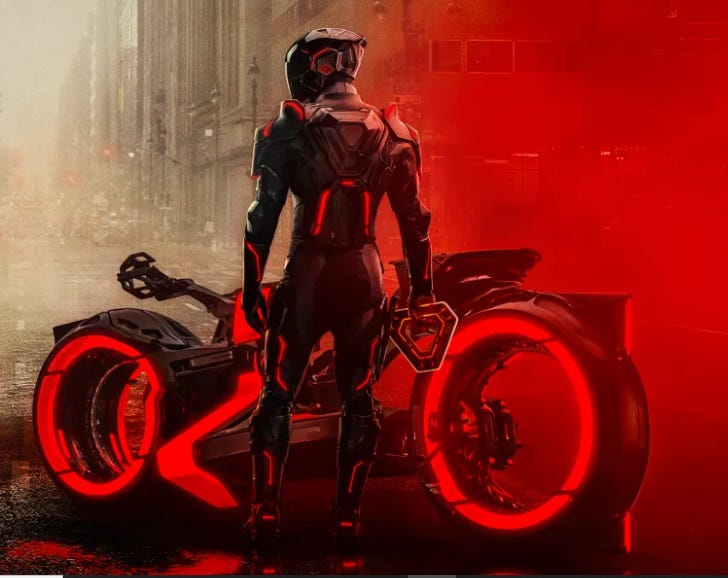
Back in April, I wrote a Substack piece about Tron: Ares. It was still months from release, and I expected it to squander its opportunity for relevance. To be fair, AI is moving fast, and movie production pipelines are slow. Using movies to comment on the present moment is hard to do in periods of rapid change, but I had a notion as to how the filmmakers could swing it. I suggested that there digital characters moving from a simulated realm into our reality would likely indicate that our reality was just another layer of simulation, and that a computer program that found itself bodily instantiated in material reality should assume that it’s in a testing environment and remain on its best behavior.
I never expected the film to try to say anything substantial about our technological moment, but so long as the release date was months in the future, I could cling to the fantasy that some element of my private head cannon could find its way onto the big screen.
Tron: Ares arrived in theaters last week. I never had high expectations for it, but in the months leading up to its premier, I thought I would see it in the theater. If the story is thin–and the reviews I’ve read, watched and listened to say it couldn’t be much thinner–that’s all the more reason to see it on the big screen. With flashy visuals substituting for a compelling premise, an engaging plot or well drawn characters, missing it on the big screen almost means missing it entirely.
Still, I haven’t seen it. I live in a rural area. Seeing a new film on a big screen means spending about 3 hours on the road for the round trip. I’m observing sober October. If that weren’t the case, I might have gotten baked and gone to see Tron: Ares in iMax and just let the visuals and Nine Inch Nails soundtrack wash over me, but given that I would be going in with my critical faculties intact, I gave it a pass. I’ll save the big trek to civilization for November and Predator: Badlands.
I’ll watch Tron: Ares from my bed when it’s available on Disney+. My TV isn’t home theater material by today’s standards, but I’ve got a subwoofer and a sound bar, which should do the NIN soundtrack justice, and I’ll make a point of listening to the soundtrack a few times between now and then so that the musical cues hit with the added vigor of recognition.
I was 14 when I saw the original Tron in the theaters in 1982. I liked it, but even at the time I knew that the premise was non-sense. There was no public internet at the time, so the idea that a Master Control Program would kidnap other programs and turn them into soldiers made no sense. Was somebody sneaking into homes and offices and stealing floppy disks? And what would it mean to conscript a copy of Oregon Trail and force it to compete in gladiatorial combat? Absurd. But, hey, it was 1982.
In 2010, at the age of 42, I saw Tron: Legacy alone in a multiplex in Nashville, TN. The film looked great, but I was disappointed that they stuck to the original premise and continued the original story. I was hoping for an updated premise that engaged with more sophisticated concerns about artificial intelligence. The spontaneous emergence of the Isos (isomorphic algorithms) was a step in the right direction, but it was a handwaive in the execution. I was not impressed. It took repeated viewings for me to come to appreciate the competent story-telling, compelling character dynamics and the amazing Daft Punk soundtrack. I now see the fact that Legacy continued the original story and premise as a strength.
Now, in 2025, I’m 57. I’m more forgiving of light, emotion-driven entertainment. In fact, like many people, I’m kinda starved for it. I don’t trust the industrial entertainment pipelines to serve up untainted entertainment anymore. Keeping my emotions in check out of wariness against manipulation in the service of a social agenda inhibits my ability to give myself over to the movie theater experience the way I could back in 1982 and 2010. Like so many people who love Tron: Legacy, I would much rather see a continuation of that story than a soft reboot that ignores the fact that Quora already moved from the Grid into the material world.
The premise of the new film is that people and constructs from the Grid that are instantiated in the real world only last for 29 minutes but that a software McGuffin crafted by Kevin Flynn in 1982 can give Grid entities stable access to material reality.
Today, I started brainstorming about how to craft a compelling sequel to Tron: Legacy given that 15 years have passed since the previous film ended. I had a great time brainstorming worldbuilding and thematic elements that would weave all three films together. I thought I’d write a quick treatment for it using the Save the Cat beet sheet, a standard Hollywood storytelling template.
In doing so I re-discovered a painful truth. When it comes to writing fiction, I’m a seat of the pants guy. I find the story by writing it, and the Save the Cat structure is particularly stifling to my process. Trying to lay out my ideas by slotting them into the placeholders on that structure is like trying to dance with a cinder block chained to my waist.
Maybe I’ll get back to my story treatment for Tron: Refuge. Maybe not. Now that I’ve admitted that I won’t finish the treatment in time to use it as my Tuesday Substack post, I don’t see the point. I don’t write fan fiction, and if I were going to start, I’d write a Star Trek / Warhammer 40K crossover. Or maybe something to do with Doctor Who. Not Tron.
So, here I am writing about not writing about Tron and not seeing the latest Tron movie even though I’ve been anticipating its premier for months. Seems kinda silly, but such are the contortions a self imposed weekly deadline incentivizes. Yesterday, Substack sent me an email saying, “Congratulations! You’ve published 96 weeks in a row.” I’ll write “All work and no play makes Jack a dull boy,” over and over again for the next four weeks before I miss a Tuesday deadline now.
I will say that I watched a few episodes of Tron: Uprising on Disney+ in the last couple of days. It’s not bad. It stars Elijah Wood as Beck, a young renegade program fighting Clu’s oppression as enacted by his general, Tesler, voiced by Lance Heinrickson. It’s not bad. It was made immediately after Tron: Legacy, back when a Disney show could put a white, male, heterosexual hero out front without any need to deconstruct or humiliate him. And unlike Tron: Ares, Bruce Boxleitner’s Tron is a recurring character in the series.
The show has such a strong visual style that it takes me out of the story from time to time. The character design reminds me a lot of Peter Chung’s characters in Aeon Flux, but in the Tron Universe. The thing I find most distracting about the visual style is that the characters all have very long legs and short torsos. It looks like the characters have all had their pelvises removed and their legs lengthened and attached directly to the bottoms of their rib cages.
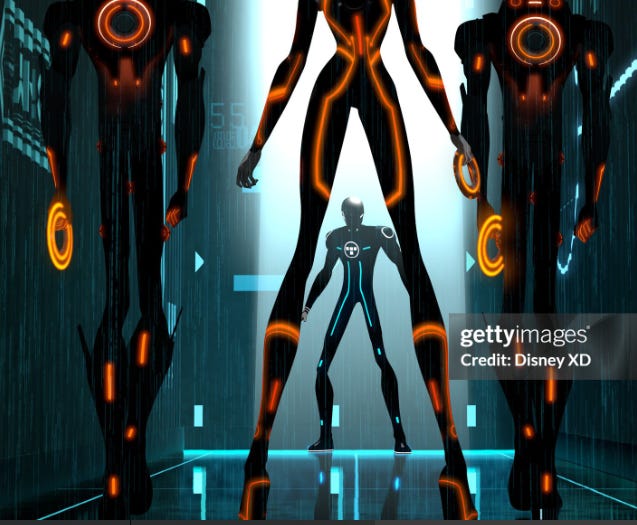
Could be. Why would computer programs need genitals? Still, there are male and female characters in this show who feel things for one another that go beyond friendship or mutual admiration. They have eyes, mouths and faces. Why not the whole package?
I’m not exactly recommending the show, but watching it is a strange experience. The competent story construction, straight-forward noble motivations of the characters, and the heterosexual dynamics all seem like something from a saner, more competent age. It’s a reminder of what we’ve lost, which is depressing, but it’s also an illustration of the sorts of entertaining science fiction and genre entertainment we can look forward to as the democratized tools for high end media construction grow in power and capability. And they are growing quickly, much to the irritation and fear of people working in the entertainment industry or who harbor ambitions of doing so.
So, there you go. Fourteen hundred words on a movie I haven’t seen. Have you seen it? If so, what did you think of it?