
Getting Over Collapse
Notes from the Other Side of the Apocalypse

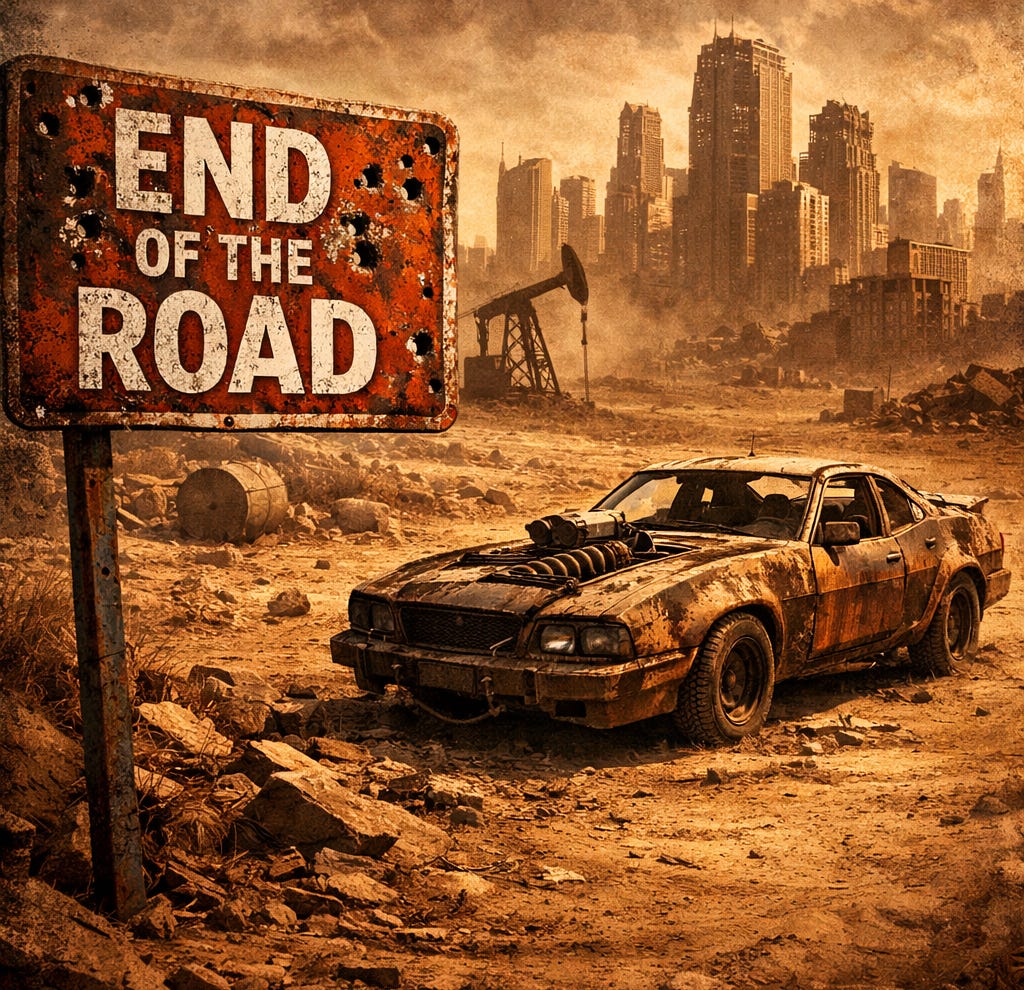
I used to be a Peak Oil Doomer. Now I’m over it.
In 2010–still a futuristic-sounding date to my Gen X ears–I was living at the Ecovillage Training Center on the Farm in Summertown, Tennessee. As often happens with my creative projects, something I’d been kicking around in the abstract sprang into high gear seemingly spontaneously. In this case it was the selection of around a dozen early C-Realm Podcast interviews that defined the future shape of the podcast which I would transcribe and assemble into a book.
In 2010, there were no large language models that could transcribe hour-long conversations in a minute or two. After I selected the interviews, I transcribed some myself, paid to have others turned from audio into text, and relied on a few generous listeners who volunteered their own time, effort and attention. The paid transcriptions were the least accurate because the subject matter was esoteric and the hired transcribers probably didn’t know or care about geology, thermodynamics, economics, or industrial agriculture. The best transcripts came from the listener volunteers.
An exact, word for word transcription of what two people say to one another over the course of a one-hour conversation doesn’t read like a magazine article or book chapter when transcribed verbatim. I had to edit the conversations for the benefit of the reader while doing minimal violence to the voice of my interlocutors. To my chagrin, I spotted errors as soon as I pulled a book from a pallet of 700 copies that arrived at the Ecovillage Training Center from the printer.
That’s another big difference between 2010 and 2026. Ebooks existed, but publishing one on Amazon.com or elsewhere was no trivial matter. So much so that I didn’t even bother. I just went straight to physical books, and I’m not talking about print on demand. I ran a Kickstarter campaign to pay for the print run and then managed the inventory myself.
Looking back on it, it seems like a daunting undertaking, but once the mania seized me, the whole project came together in what feels like a few short weeks. At least that’s how I remember it now. Still, it had been an idle notion for a long while, then the spirit of completion animated me for a short period, and thereafter I had a stock of books that I could use as both the central prop and financial fuel for multiple cross-country couch-surfing speaking tours. That prop is the book Conversations on Collapse: C-Realm Podcast Transcripts. There was never a second printing, and used copies on Amazon.com are listed at silly prices.
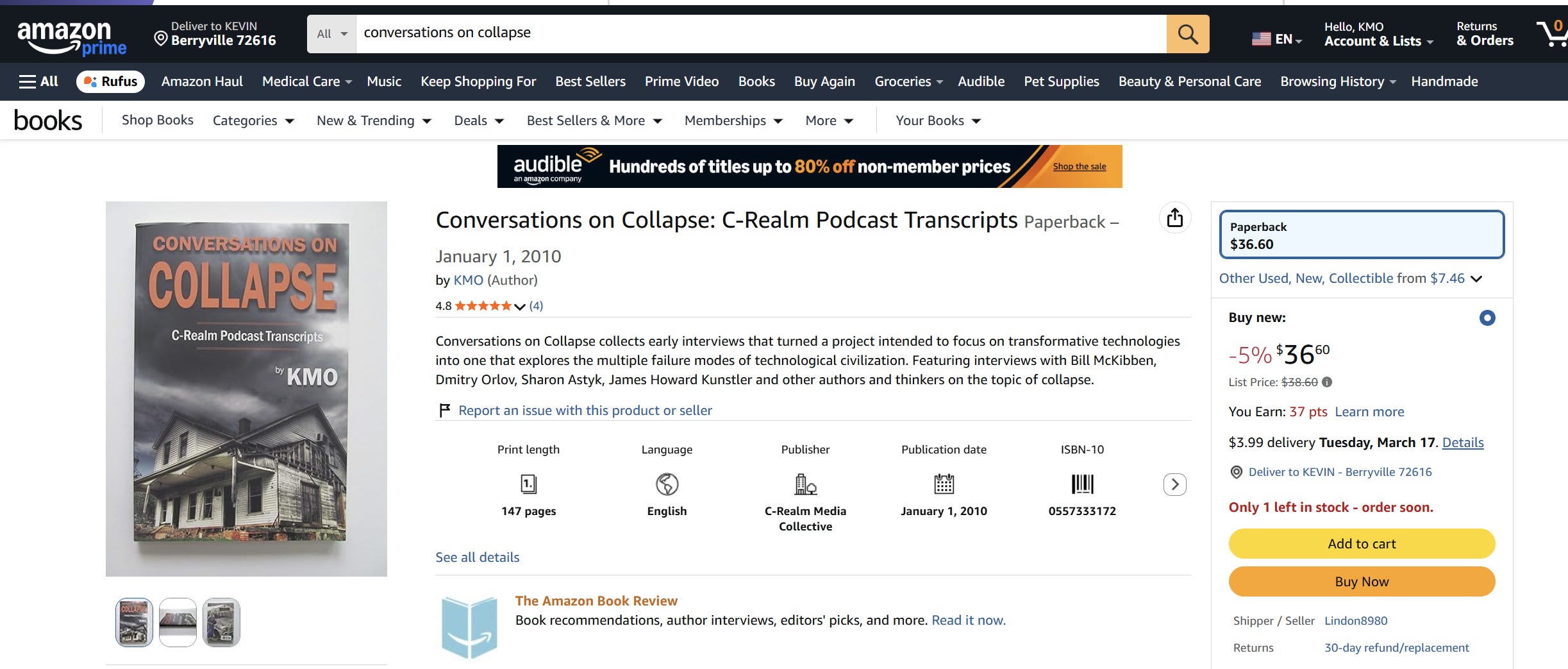
While that out-of-print book is expensive to acquire now, you can read some of those transcripts for free on the C-Realm Blogspot blog. That site had been dormant for many years until just recently when the “maybe someday” notion of doing a follow-up to Conversations on Collapse caught an energetic wind and leapt into motion.
I just re-branded the site as the Getting Over Collapse Notebook, and I’m reviewing my old material with the help of LLMs to chart the evolution of my thought and creative output as I moved from an articulator of the Peak Oil fast collapse narrative to someone who now describes himself as being “over it.”
What’s the relevance? Why write about it here other than as an excuse to link to the repurposed Blogspot site?
This Substack blog is called Gen X Science Fiction and Futurism, and in some respects thermodynamic fatalism–AKA Peak Oil Doomerism–is futurism gone wrong. People I knew based major life decisions on the Peak Oil narrative. In very few cases do I imagine they’d double down on those same choices if they had it to do over again. That link is easy enough to make. But looking back on my own journey through the Peak Oil scene of the late aughts and early twenty-teens, I also see a strong science fiction angle — and a distinctly Gen X one.
I hold that 20th Century science fiction imbued us with faulty expectations around artificial intelligence. “Computers” were something people my age encountered in science fiction television and movies long before we encountered them in real life. SF conditioned us to imagine that AI would be logical to a fault. The idea that AI would learn to handle light and texture like a Renaissance master before it could reliably count the fingers on a human hand never featured in any science fiction story I ever saw or read in the 20th Century. The notion that AI would be able to compose serviceable sonnets, limericks and haiku before it could reliably count the number of Rs in the word “strawberry” is also alien to the expectations Boomers and Gen Xers carried into the 21st Century.
As much as robots, spaceships, aliens and time travel are fixtures of science fiction storytelling, so too are civilization-ending cataclysms and the post-apocalyptic wastelands they leave behind. From childhood, I inhabited bleak sci-fi futures from Planet of the Apes to Thundarr the Barbarian to Mad Max to the zombie-infested landscapes of George A. Romero’s [blank] of the Dead films1 and their many imitators.
The struggle for survival in the ruins of our familiar world was the point of these stories. The explanation for the collapse was a mere genre formality. Scientific, economic, or sociological rigor was not required. The premise was a permission slip for adventure. It only needed to seem vaguely plausible.
The last thing most writers and consumers of such tales were interested in was a nuanced examination of the sorts of homeostatic feedback loops that keep complex adaptive systems from crashing like a Jenga tower. Sci-fi writers tended to offer a single cause for the collapse. Pull one block and the tower collapses. The audience didn’t require anything more. The classic science fiction fall of civilization tropes were nuclear war and pandemics.
Even the zombie apocalypse, so unrealistic that it was often presented with no explanation at all, grew out of a pandemic story, Richard Matheson’s I Am Legend. In the original novel, the POV character is the last normal man in a world in which a strain of bacillus bacteria has killed everyone else or turned them into vampires. Those vampires were the inspiration for the ghouls–retroactively identified as zombies–in Romero’s Night of the Living Dead. Later “zombies as infected” stories like 28 Days Later and its sequels and copycats also appealed to virulent pathogens to justify their stories of life or death struggle in the ruins of a fallen civilization.
I’m 57. I was 32 on January 1st, 2001, the first day of the 21st Century, so I have still lived more of my life in the previous century than I have in this one. I hope and expect that to change in a few years, but no matter how long I live, I think I will always be a child of the 1970s and an immigrant from the Cold War. To me, the 1980s is my temporal old country, the land whose accent will always taint my speech.
The Boomers grew up on optimistic visions of the future they inherited from the Silent and GI generations that came before them, and it was against the simplistic vision of technological progress on display in Golden Age science fiction and the jingoistic alien invasion stories of the Red Scare fifties that the Boomers–the Prophet generation–rebelled. They gravitated to visions of corruption, degeneration and collapse. Gen X grew up on that stuff.
I’m pretty sure I saw The Road Warrior (the American title for Mad Max 2) before I ever saw the original Mad Max. The Road Warrior came out in 1981, but I didn’t see it in the theater. I saw it on VHS in probably 1983 or ‘84. It’s a story about a group of idealists defending an oil well and refinery against punk rock, biker barbarians. The stranger, Max, risks his life for gasoline.
It’s a story about the struggle for the remaining supply of the life blood of industrial society, but I never looked at it that way until the Peak Oil narrative sank its claws into my consciousness. Before Peak Oil, it was a paradigmatic example of post-apocalyptic science fiction. After Peak Oil, The Road Warrior became a work of sacred prophecy. Revisiting the opening narration still gives me chills:
My life fades, my vision dims. All that remains are memories. I remember a time of chaos, ruined dreams, this wasted land. Most of all, I remember the man we called Max, the road warrior. To understand who he was we have to go back to the other time. When the world was powered by the black fuel, and the desert sprung great cities of pipe and steel. Gone now, swept away. For reasons long forgotten two mighty warrior tribes went to war and touched off a blaze which engulfed them all. Without fuel they were nothing. They’d built a house of straw. Suddenly their machines sputtered and stopped.
“Holy shit,” I realized at age 38. “Mad Max was about the Peak Oil collapse.”
Civilization fell because a cataclysmic war disrupted fossil fuel supplies. Today, the idea that a complex adaptive system would fail catastrophically in response to a single, discrete shock, seems simplistic, but to a mind trained on decades of thin accounts of the fall of the old world, it seemed plausible enough to be scary. Particularly when smart-sounding people with charts and data seemed to be getting pretty freaked out about it.
People didn’t invest their attention in the Peak Oil fast collapse narrative because they were stupid. Peak Oil drew from geology, petroleum engineering, economics and even systems theory–though selectively–to weave its tapestry of near-term collapse. To understand how critical oil is to modern life required learning about and paying attention to things most people took for granted. You felt smart when the implications clicked into place. Smart and freaked out.
There was a moral dimension as well. The forward-looking few, those who renounced the status trappings of modern society and learned genuine survival skills, those who learned to tend the Earth, keep chickens, store food, and build bonds of local community would survive when everyone else was taken unaware by the catastrophe the select few saw coming. Potent stuff.
And then there was the conspiracy element. “The government knows. They KNOW, man, and they’re keeping it quiet. Extend and pretend.”
The investment in narrative complexity, the allure of being one of the select few, and the psychic conspiracy spice made for a potent cocktail.
And then there was the promise of a better, saner, more local and human way of life after the hardship of the transition faded. We’d live according to the seasons, conscious of Nature’s limits and our place in the web of life.
When I lived at the Ecovillage Training Center I saw a continuous stream of dissatisfied seekers pass through on their pilgrimage from Dancing Rabbit, through the Farm, to Twin Oaks. Young people who wanted to buy some land and create a self-sufficient farming community. It was an alluring dream and a nearly impossible task. Who knows how many people inflicted lasting financial injury on themselves in pursuit of that vision?
Peak Oil prophets used to explain the obtuse nonchalance of the normie with an appeal to the psychology of previous investment. The more time, effort, reputation and resources you devote to an idea, the harder it is to look at it with a critical eye. But the Doomers didn’t seem to understand that the same dynamic played out in their relationship to the promise of collapse.
The point of Getting Over Collapse is not to denounce, condemn or ridicule the people who fell for it. I fell for it.
Hopefully, unpacking both the flaws in the narrative and its appeals, I can help young people reconcile their dissatisfaction with contemporary society with a realistic understanding about how civilizations behave under stress.
And then there’s AI. The prophets of doom said we’d all be scratching a living out of the dirt long before AI would ever be a thing. Nope. It’s here. It’s a thing. Possibly a very big thing.
Diffferent prophets are weaving stories of fear and wish fulfillment around AI the way others did around thermodynamic collapse. Now’s a good time to get good and familiar with the psychology of transformative change.
Night of the Living Dead (1968), Dawn of the Dead (1978), Day of the Dead (1985), Land of the Dead (2005), Diary of the Dead (2007), and Survival of the Dead (2009)
I've mentioned this before, but I joined up for the c-realm vault for #89 in april 2014, after you hinted on the main c-realm at having more thoughts on Michael Ruppert's suicide. I don't know if that one was near the inflection point for your views, but I definitely found it the most powerful.
Some sample quotes from re-listening to that one, especially from listener Frank's email reflecting back what thoughts you were putting out:
- you were raising the alarm that "people were using the collapse narrative to create a death-cult"
- "to what extent is the collapse narrative a projection of peoples' inner demons, working their way into a public spectacle?"
I think personally around that time, I was trying to spread the whitepill of MMT to help people off the ledge of economic/financial doomerism (of the type in the first portion of this vault episode, speaking with ilargi). I mostly missed the peak-oil ecological collapse community at that point, other than keeping tabs on the /r/collapse sub as a tourist. But I definitely had the experience of being tempted into blackpill doomer 'potent cocktail' understanding of the world when dealing with my own lowpoint depression around 2007-2010. And indeed that it fell away again when my own situation turned around.
I cannot remember exactly how I came to the c-realm. If it was via the ETC podcasts ‘08(?) or Knutstler(when it was still urbanism). I was never a doomer, but enjoyed your variety of voices Doug Lain(diet soap), the Arch Druid, Ayahuasca etc. z-realm too! Always memorable engaging conversations. And topics I might not have considered.
Your deep dive into AI sometimes is more than I can track week to week. Still it is my source of trying to comprehend the technology and potential.