
The Spreadsheet and the Doomstead
What really killed the Peak Oil movement

The Peak Oil scene was a temporary truce between otherwise incompatible tribes, held together by a shared sense that industrial civilization was nearing an energy-driven reckoning. When that reckoning failed to arrive on schedule and in the expected form, the truce dissolved and the tribes went back to being enemies.
I spent this morning turning a rough assembly of podcast interview clips into a finished podcast. The clips were from C-Realm Podcast interviews mostly recorded in 2007 and early 2008 with the likes of Dmitry Orlov, James Howard Kunstler, Albert Bartlett and Bill McKibben. My podcast guests didn’t all agree with one another, but taken together their perspectives blended into a portrait of a civilization fixated on unworkable objectives and addicted to unsustainable consumption of non-renewable resources.
Early 2007 was an impactful historical moment in which to develop a sustained interest in Peak Oil and The Limits to Growth. I spent a year and a half talking to charismatic and articulate purveyors of contrarian worldviews, and then when the subprime mortgage crisis morphed into a more general economic crisis that dominated news headlines for months on end, events seemed to validate the fast collapse narrative. For me, catastrophic collapse graduated from an abstract possibility to a private eschatology. The expectation of societal collapse became a load-bearing pillar of my self-conception as someone who could see what others either could not understand or refused to consider.
When I reflect on that period in my life, I condense it down to my Peak Oil Doomer phase emphasizing how caught up I was in a timeline of forecasts that never materialized. Listening to the podcast excerpts reminded me that Peak Oil wasn’t just about geology, production curves and prices. The people I talked to explained why life under industrial civilization felt inauthentic and unsatisfying. The message wasn’t just that industrial civilization was on its last legs but that, despite the trauma of the transition to a post-industrial existence, the prospect of collapse carried with it the anticipation of relief–relief from a sort of chronic stress human minds and bodies never evolved to process. I’m talking about financial stress and the stress that comes from the widening gulf between self-definition as a member of the middle class and the material affluence required to maintain that status.
Even Boomers and members of the Silent Generation with a comfortable financial buffer felt vicarious stress on behalf of their children and grandchildren. In 2012, I attended the final Age of Limits Gathering at a rural enclave in Southern Pennsylvania. The community leader and conference organizer had built his following around a fast collapse narrative. He and his adherents anticipated a cascading failure of technological infrastructure so rapid it would play out over days and weeks rather than years and decades. They called it the zombie apocalypse.
Much to the conference organizer’s annoyance, I held a separate breakout session one evening for C-Realm Podcast listeners and anyone else who wanted to attend. The people who opted for the C-Realm breakout session didn’t want to talk about subsistence gardening or perimeter defense. They were mad that young people were carrying crippling student debt that made home-ownership and family formation an impossible dream. That’s not the worry of someone anticipating the zombie apocalypse.
Looking back on gatherings like that one, I realize that the Peak Oil scene represented more than just forecasts that didn’t come true. It was a manifestation of growing discontent with stagnant prospects for young people and a growing economic divide. Still, the apocalyptic edge of fast collapse scenarios infused an otherwise esoteric subject matter with visceral real world relevance that bridged ideological difference. The Peak Oil scene brought contrarians with disparate personalities and ideologies into a temporary convergence of people who, under normal political conditions, were not natural allies:
right-wing survivalists
gold bugs and anti-fiat cranks
hippie pastoralists and back-to-the-landers
systems thinkers and academics
left-leaning ecological critics
pragmatic homesteaders and farm-to-table foodies
Their shared dissatisfaction with contemporary life and the expectation that a discontinuity would soon open up possibilities for radical change held an otherwise volatile coalition together… for a while.
It would be nearly impossible to bring that coalition back together in today’s culture of extreme polarization and embattled identities. A coalition that once cohered around thermodynamics, depletion, and fragility would now get immediately pulled apart by alignment pressures around regime legitimacy, Trump, COVID, Ukraine, immigration, climate politics, AI, and the general friend-enemy sorting mechanism of American discourse.
In 2018, 20 years after Scientific American published a paper by Colin J. Campbell and Jean H. Laherrère titled “The End of Cheap Oil,” Professor Ugo Bardi conducted a deep dive into the failure of the Peak Oil movement. He rejected the simplistic notion that people lost interest in Peak Oil because of failed predictions. He argued that:
Many of the most technically rigorous predictions held
ASPO’s1 projections for peak extraction were too pessimistic but fundamentally correct
The apocalyptic predictions that attached themselves to Peak Oil over-reached the theory
The first point is solid, but irrelevant. Without the immediacy the threat of a dramatic collapse brought to the table, Peak Oil theory as articulated by people like Campbell and Laherrère would be of little interest outside of academia and policy think tanks. Without the drama, no popular movement around Peak Oil could coalesce.
The second point, that ASPO’s timeline for depletion was too extreme but not fundamentally wrong, hasn’t fared well in the 8 years since Bardi’s twenty-year lookback. ASPO predicted oil production would follow a bell-shaped curve over time and reach an all-time production peak in 2010. We’re now past the halfway point of the 2020s and actual production doesn’t match that projected curve. A tech industry aphorism holds that too early is the same as wrong.
That said, I agree that overly pessimistic technical predictions don’t account for the loss of popular interest in Peak Oil.
As for the garish Doomsday scenarios that grew up in the popular narrative around Peak Oil, sure, they aren’t derived from the disciplined theoretical core, but they brought the plant breeders and the raw-milk fanciers, the ecovillagers and the ammo stackers, the climate change activists and the hard currency fanatics together. Without the inter-tribal interest that formed around the prospect of a near-term societal disruption, Peak Oil is just an esoteric topic for petroleum geologists and policy wonks, not something that would make anyone want to quit their office job and raise goats in a remote doomstead.
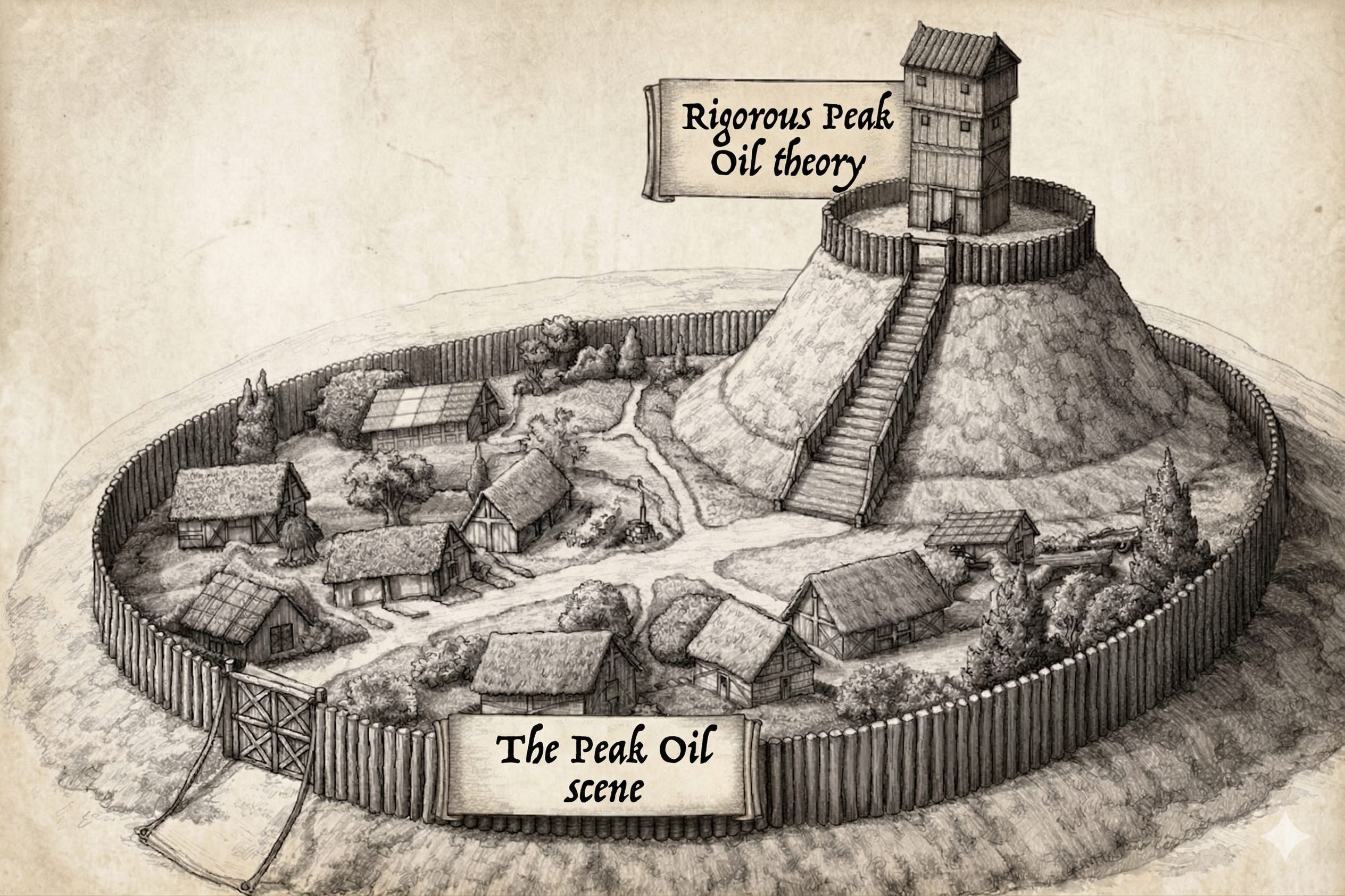
To claim that the Peak Oil movement failed because extraneous and unserious apocalyptic baggage weighed it down is something of a motte and bailey move. The rigorous and sober technical theory is the motte, the elevated stronghold. The popular movement that mixed technical analysis with vivid zombie apocalypse scenarios is the bailey, the collection of buildings inside a perimeter fence adjacent to the more secure motte. You can’t defend the legitimacy of the bailey by appealing to the rigor of the motte. The scene is down in the bailey. At least, it used to be.
The Peak Oil moment has passed. That ground has shifted. Woe be unto him who built his identity upon it.
ASPO - Association for the Study of Peak Oil (and Gas)
I had more than one toe in the Peak Oil movement. Got some land in a place where it rains, career in alternative energy, figured out how to get to work without a vehicle if I want to. Sure the timing was off but I still could have 30 years left on this insane prison planet for things to unfold. Wack as he was sometimes I took Dmitry’s advice don’t do anything you wouldn’t do anyway.
Your final sentence was particularly poignant to me. I built my career not on peak anything but on hippy commune née intentional community née ecovillage and am suffering buyers remorse. There is a there there but being too early is the same as being wrong.